Showing posts with label Trinidad-Tobago. Show all posts

Thursday, April 11, 2013

Trinidad: White-winged Swallow - Tachycineta albiventer


On our last day in Trinidad we stopped for lunch at a beach and got to see the White-winged Swallow, Tachycineta albiventer, on a wire along the street. This is a non-migratory species that resembles our Tree and Violet-green Swallows (same genus), but as you can see from this marginal photo the white on the wing makes the I.D. straightforward. They are non-migratory and are not gregarious like many swallows. The white wing patch is the dorsal surface of the inner wing feathers, i.e. the secondaries and tertials.


It's hard to research neotropical birds without an extended library, so I often use the internet. Good old "Cornell Lab of Ornithology" often provides great background information on our southern avifauna. See: http://neotropical.birds.cornell.edu/portal/species/identification?p_p_spp=523116

The referenced link provides some excellent information of the sometimes changing taxonomy. "Tachycineta" is a "swift mover" (Holloway). There are some 83 Swallows worldwide (family Hirundiniidae), nine species in the genus Tachycineta. White-winged Swallow has no subspecies.

Saturday, April 6, 2013

Tobago: Least Grebe - Tachybaptus dominicus

We saw the Least Grebe (Tachybaptus dominicus) on Tobago, at a development call Plantation Village. Got some nice views of a parent swimming with 3 striped youngsters. Photo ops were marginal, so I'm including a shot of a Least Grebe from Texas, taken at Sabal Palm on a wonderful Bob Stewart trip in 2005.


Grebes are an "easy" group to get you head around. The entire Order Podicipediformes, the Grebes, contains only 19 species world-wide. We are fortunate to be able to see 6 grebe species on the west coast of California, sometimes at one location such as Bodega Bay, plus the Least Grebe in Texas. In T-T they have only the Least Grebe and the Pied-billed Grebe.

Least Grebes are really small, measuring 8-10" and weighing 4-6 oz. Compare that to the Pied-billed Grebe at 1 lb.! In Trinidad-Tobago the subspecies is T. d. speciosus, with a range that extends south to Argentina and Brazil. Least Grebe is found on fresh water ponds and marshes, and like other grebes they feed by diving for small fish and invertebrates, staying down up to 12 sec. Tachybaptus means "fast diver". Their head and especially the throat gets blacker in breeding plumage, as here. They tend to be resident in the area where they are found, and on Trinidad-Tobago they are not common.

Taxonomy: The 19 Grebe species are sorted into 6 genera. The genus Tachybaptus has 4 species, with the Little Grebe, Australasian Grebe and Madagascar Grebe joining the Least Grebe. Clearly you're going to have to travel quite a bit to see them all. Our Pied-billed Grebe is the only Podilymbus grebe, and Western and Clark's Grebes are the only Aechmophorus grebes. 8 of the grebe species are in the genus Podiceps, including our Horned, Eared and Red-necked Grebes. Worth looking for right now, btw, all are in striking alternate plumage. The other 2 genera are Rollandia (2 South American species) and Poliocephalus (2 species in Australis/New Zealand).

Sunday, March 24, 2013

T-T: Rufous-tailed Jacamar - Galbula ruficauda

"Jacamar!" It has quite ring to it, and the bird itself more than delivers. Imagine a giant hummingbird that hunts from a perch like a flycatcher and sallies out to catch any an every sort of flying insect on the wing. Like a hummer, it has a long pointed pill, iridescent green back, and even tiny feet. Note the rufous chest and white throat. They build nesting tunnels into a sandy bank, like kingfishers and motmots
No relation to hummers, of course, as the Jacamar family (Galbulidae) is in the order Piciformes, along with the Woopeckers, Puffbirds, Barbets, Honeyguides and Toucans. I would have guessed the Jacamars were in the Coraciiformes, along with the Motmots and Bee-eaters, but not so, although they are closely related orders.

Taxonomy-
There are 18 species in the Jacamar family, distributed among 5 genera. They are New World only, like the hummers, and range from SE Mexico well down into tropical South America.

The genus Galbula is the largest, with 10 species. The Rufous-tailed Jacamar, G. ruficauda, is the most numerous and wide-ranging of the jacamars, and is found from Mexico down to northern Brazil and Argentina. Trindad-Tobago has the nominate subspecies, G. r. ruficauda. T-T has only one Jacamar, just as it has only one Motmot.

The bird seen here was about 30 yards away, so forgive the lack of sharpness.

Tuesday, March 19, 2013

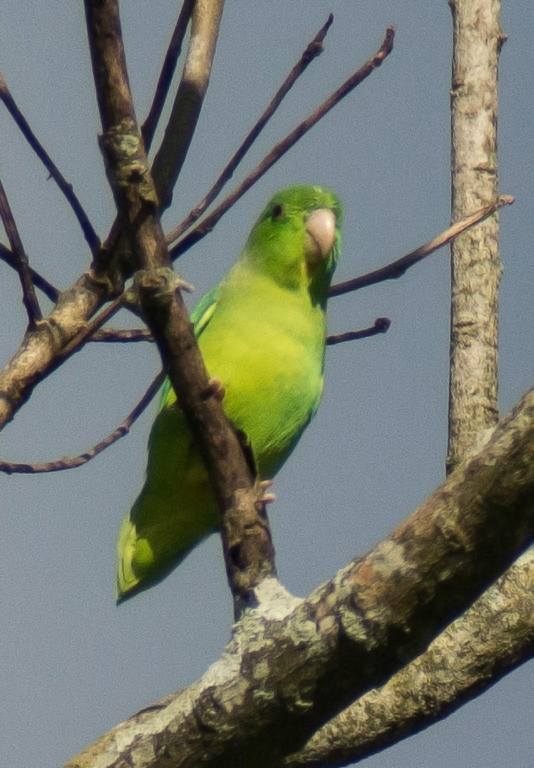
T-T: Green-rumped Parrotlet - Forpus passerinus

We saw or heard 3 members of the Parrot Family (Psittacidae) during our Trinidad-Tobago trip. The Green-rumped Parrotlet likes semi-open areas like savannas and suburban locales, and is the smallest of the 4 parrot species normally seen on T-T (9 parrots are listed, but some accidental or rare).

These shots were at the Aripo Livestock Station, a government facility with open space and some marshy areas. Birds here not close, so cropping of photos reduces the quality. This bird seems to be the male Green-rumped, as the female has a yellow-green forehead. Very small parrot, at 5.5" - thus the name Parrotlet or sometimes Parrakeet, or Parakeet.


Taxonomy-
Parrots are in the Order Psittaciformes, an order with only one family, the Parrots (Psittacidae).
Maybe only one family, but lots of members worldwide, with some 360 species in 80 genera. They range from the tropical to temperate climes, and some have established themselves as far north as Connecticut (Monk Parakeet). The genus Forpus has 7 species. The Green-rumped, F. passerinus, has 2 subspecies - this one if F. p. viridissimus, seen in Trinidad, Venezuela and Columbia.

Monday, March 18, 2013

Trinidad Motmot - Momotus bahamensis

We were lucky to see the Trinidad Motmot, Momotus bahamensis, on 5 of our 8 birding days in T-T, but most times it was partially obscured, or too far for a photo.


The Motmots are a New World family in the order Coraciiformes, joined there by other rather striking birds like the Kingfishers, Bee-eaters, Rollers and Hornbills. There were about 10 Motmot species until about 2009-2010 when authorities concluded that the subspecies in the Blue-crowned Motmot "complex" were sufficiently distinct geographically and genetically as to warrant full species status. Thus the Blue-crowned was split into 5 separate species (now including the Blue-crowned, Trinidad, Whooping, Amazonian and Andean Motmots). The Trinidad Motmot, is found only on Trinidad-Tobago, not ranging even to the nearby mainland of Venezuela.

Second photo here lacks sharpness but is included to show the specilized long tail feathers that end in a racket-shape.


The Trinidad Motmot has a deeper rufous color below than the other blue-crowned types. The rich rufous is compliment by a green back, blue wings and a striking blue and turquoise on the head. Any description begs comparison to seeing the bird in the wild. Hopefully the photos will suffice for those who don't plan a trip.

Motmots nest in long tunnels that they dig into a bank, much like our Belter Kingfishers. They eat mostly insects prey, caught in sallies from an open perch. The specialized long tail feathers end in a racket-shape, sometimes hidden when perched. Juveniles resemble the adult, but lack the black spot in the upper chest.

Saturday, March 9, 2013

T-T: Great Kiskadee - Pitangus sulphuratus

The Great Kiskadee, Pitangus sulpuhuratus, is a large noisy agressive flycatcher seen from Texas down to Argentina. Very similar in appearance to the Boat-billed Flycatcher, but the Kisdadee is more common and has a exuberant and distinctive "kiss-ka-dee" call. Both species have long bills, but the Kiskadee's is not as broad at that of the Boat-billed. Included here is a photo of the back of the head, showing how the white supercilliary stripes join at the nape, whereas they don't meet on the nape of Boat-billed. Both species have some yellow on the crown, but not always seen in the field. The black mask may help reduce glare and thus improve the ability to spot prey (ffrench). Some other birds that hunt from a perch share the black mask, as we saw with the Gray Kingbird, Shrikes, etc.


The Great Kiskadee doesn't migrate, and is a monotypic species. The similar Boat-billed FC and Lesser Kiskadee are in different genera. The Kiskadee is omnivorous, and is described as "extremely pugnacious and strongly territorial". Known to harass even monkeys, raptors and snakes! Of particular interest is that it has evolved to distinguish the color patterns of the venomous Coral Snake (Nature: 265:535). It's "method of foraging is to sit, shrike-like, on a perch, diving down to pick up prey often near the ground, whence it returns to the perch and proceeds to batter its victim to death".(ffrench- Birds of T & T).


Taxonomy- Monotypic, i.e. no other species in the genus Pitangus. There are however 10 subspecies, with P. s. trinitatis the one seen in Trinidad. The species is largely absent from Tobago.

Thursday, March 7, 2013

Trinidad-Tobago: Tropical Kingbird

The Tropical Kingbird, Tyrannus melancholicus, is one of the 11 Kingbirds in the Tyrannus genus, and perhaps the most commonly seen of all, with a range from southern Texas and Arizona extending south to include most of Central and South America. We saw this one on a post in the Aripo Savannah in Trinidad, but it also occurs on Tobago. The subspecies seen in T-T is the same that we see in the U.S., including a few in the Bay Area along the coast every winter. It T. m. satropa. Despite the wide range of the species only 3 subspecies are recognized.


The Tropical Kingbird is seen so often in Costa Rica that the guides simply called out "Tee-Kay", if they bothered to even note it. Guess we do the same with our "Tee-Vee" for the Turkey Vulture.

Bird seen here quite backlit, but we can still appreciate the gray head with a vague black "mask" on the face. The long bill helps tell it from some of other yellow-bellied Kingbirds, like our, Couch's, Cassin's and Western Kingbirds. The shadowed underparts allow us to see the olive-yellow color of the upper breast.

Monday, February 18, 2013

Trinidad: Green Honeycreeper - Chlorophanes spiza


The male Green Honeycreeper, a very common sight at Asa Wright, is shown here in all his blue-green finery, with a black face and cap. His iris is red, and the lower mandible is yellow. The female and the immature birds are quite green, and I presume the mottled bird in the 3rd photo is a young male molting from green into his adult male plumage. Sorry, but I totally forgot to get a shot of the green female!


The Honeycreepers used to have their own family (Coerbidae), but they've been moved in with the Tanagers, and are now are in the larger family of Emberiziae. This is not exactly "need to know" stuff, for sure. What is of interest is that the Honeycreepers are specialized nectar feeders, just like the hummingbirds, with bills adapted to reach deep into the nectary of a flower. There are only 5 Honeycreepers - 4 of them in the genus Cyanepes, and this one, alone in the genus Chlorophanes. Chlorophanes spiza does, however, feature 7 subspecies, and this one is probably the nominate race,  C. s. spiza. As a group they range from Mexico down to Brazil.

Here's the molting young male, to show the marked difference between the green shade of the younsters and females and the blue-green of the adult male.


Monday, February 11, 2013

Trinidad: Palm Tanager - Thraupis palmarum

The Palm Tanager, Thraupis palmarum, is a close relative of the Blue-gray Tanager, and is probably even more common. The Palm has a range that extends from Nicaragua to souther Brazil. Breeding by the Palm Tanager has been documented in every month (ffrench), but occurs mostly from Maarch to August. Wild hybrids with the Blue-gray Tanager have been documented. Male and females have similar plumage.


The Palm Tanager is far from the showiest bird in the tanager family, sporting a dull mixture of olives and grays, with the darkest grays on the flight feathers and tail. They are social birds, sometimes foraging in small flocks, while eating a variety of fruit, nectar and insects. There are 4 subspecies in all. As mentioned recently the genus Thraupis has seven members, with 3 found on Trinidad-tobago. The Blue-capped Tanager is the 3rd of the group on Trinidad, but is found only in forests above 2,000', and is not seen often.


Trinidad-Tobago: Bananaquit


Here's the ubiquitous and colorful Bananaquit, Coerba flaveola. We not only encountered the Bananquit every single day, we usually saw scores of them, and a few even entered the dining room at Asa Wright to inspect our plates. The Bananaquits readily sip from the hummingbird feeders, often dominating them, and are seen on the flowers of virtually every flowering tree in Trinidad-Tobago. They also eat fruit, and probably some insects.


The ornithologists have not decided where to put the Bananaquit in the taxonomic heirarchy. It once was given it own monotypic family (Coerebidae), and today is often included in the Tanager Family (Thraupidae). The AOU remains on the fence about it, placing it in Incertae sedis, which means "position unknown", a group of birds that have uncertain relationships with established families. Some authorities suggest that the multitude (30+) of Bananaquit subspecies differ enough that they should be split into 3 or more distinct species! Richard ffrench (Birds of Trinidad-Tobago) wrote that some authors considered it to be a Wood-warbler!


Will follow this up with more birds from the Tanager Family, so taxonomy buffs may want to check this current Wiki reference:


You'll note that some of your favorite U.S. Tanagers, in the genus Piranga, have been taken out of the Tanager Family and are now in with the Cardinalidae! Heck, if they can more the Falcons to a position between the Woodpeckers and the Flycatchers, anything's possible!