Showing posts with label White-belted Ringtail. Show all posts

Wednesday, July 20, 2016

Clubtails along Bear Creek


On our July 16 visit to Bear Creek with Tim Manolis and Leslie Flint we were happy to find 2 species of clubtails, The White-belted Ringtail and the Gray Sanddragon.

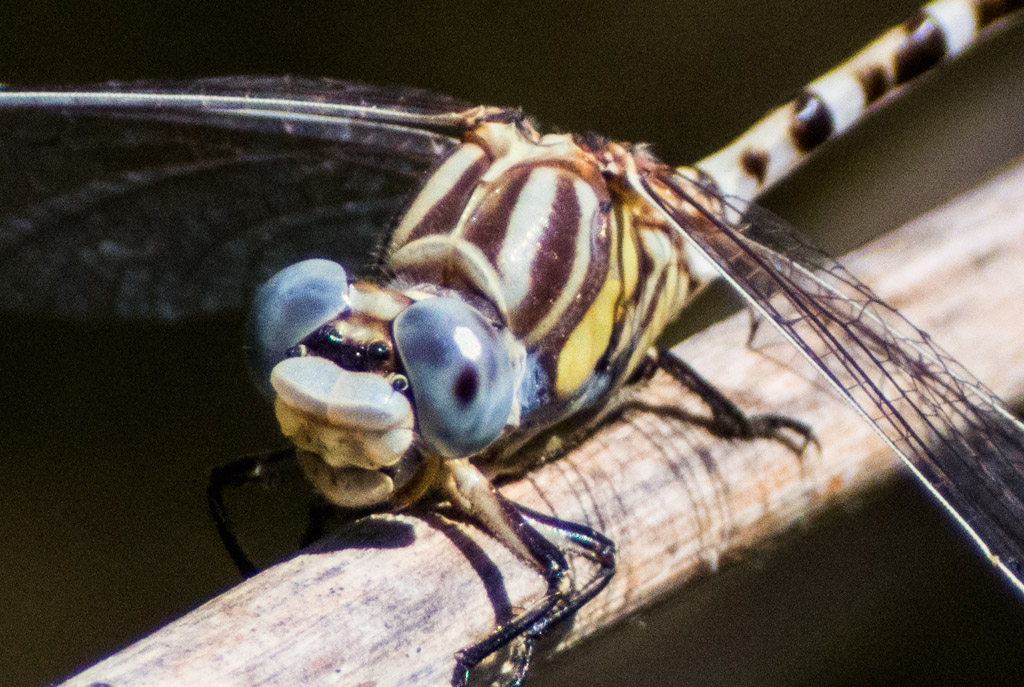
The White-belted Ringtail, Erpetogomphus compositus, has an well-chosen scientific name, as "compositus" suggests tit has multiple varied features. Indeed, it looks like a colored drawing filled in by a artistic youngster. Gray face, blue-gray eyes, multi-colored stripes on the thorax, white rings on along the black abdomen, and yellow-orange on the last 3 segments of the abdomen that form the "club" on the male. The female otherwise looks similar. 


They often pose for a while on the same rock. This one turned to face the audience. Dragonflies have quite a range of rotation between the head and the thorax. The widely separated eyes is a common feature of the clubtails (see text at end).


The Ringtails, genus Erpetogomphus, make up one of about 13 genera of dragonflies in the family called Clubtails, the Gomphidae (see below). There are 22 species in genus Erpetogomphus, of which 6 are seen in Western U.S. (Paulson) with only 2 in California (Manolis). Ringtails are restricted to the Americas, whereas other clubtails may have a worldwide distribution. Like most Clubtails, the Ringtails are found along rivers and streams. Most of the 22 species have more green color.

A marginal shot of a female White-belted Ringtail found by Leslie.


There is a bridge along the road to Wilbur Hot Springs (resort destroyed by fire), which allows access to gravel-lined shoreline below it that is a favorite habitat of the Gray Sanddragon, Progomphus borealis. This may be a female, lacking a clubbed tail. Note the prominent light-colored flat cerci at the end of the abdomen.


From a 2013 post:

The Clubtails as a family are indeed very diverse, with at least 13 genera seen in the U.S., including Sanddragons, Leaftails, Forktails, Hanging and Pond Clubtails, Common Clubtails, Least Clubtails, Spinylegs, Dragonhunters (gotta love that one!), and Grappletails. All Clubtails have widely separated eyes (check out the close-up here), compared to the eyes of most dragonfly families where the eyes are close and often touch at the midline, and most are found along rivers and streams where they choose a horizontal perch. Worldwide, there are a total of about 90 genera in the Clubtail family, numbering some 900 species. Quite a group to study, although not nearly as numerous as the Skimmer family, Libellulidae.

Tuesday, September 10, 2013

White-belted Ringtail - Erpetogomphus compositus

Leslie Flint spotted this male White-belted Ringtail, Erpetogomphus compositius, hunting low near a riffle along Bear Creek, August 28th. She followed it to a perch, where it obliged us by staying a while for photographs. 

The White-belted Ringtail has an well-chosen scienticfic name, as compositus suggests that may have very varied features. Indeed, it looks like a colored drawing filled in by a artistic youngster. Gray face, blue-gray eyes, multi-colored stripes on the thorax, white-rings along the black abdomen, and yellow-orange on the last 3 segment of the abdomen that form the "club" on the male. The female looks similar, but without a clubbed tail end. 


The Ringtails, genus Erpetogomphus, include about 22 speciesof which 6 are seen in Western U.S. (Paulson), but only 2 in California (Manolis). Ringtails are restricted to the Americas, whereas other clubtails may have a worldwide distribution. Like most Clubtails, the Ringtails are found along rivers and streams, usually those with a gravel or sandy bed. Most of the 22 species are more green in color that this wild composite. Here's a closer view of the remarkable eyes and face:

Cropped view of the White-belted male, to show face and thorax detail
The Ringtail are just one of about 13 genera of dragonflies that make up the Clubtail family called Clubtails, the Gomphidae. The Clubtails as a family are indeed very diverse, with at least 13 genera seen in the U.S., including Sanddragon, Leaftail, Forktail, Hanging and Pond Clubtail, Common Clubtail, Least Clubtail, Spinyleg, Dragonhunter (gotta love that one!), and Grappletail. All Clubtails have widely separated eyes (check out the close-up above), compared to the eyes of most dragonfly families where the eyes are close and often touch at the midline, and most are found along rivers and streams where they choose a horizontal perch. Worldwide, there are a total of about 90 genera in the Clubtail family, numbering some 900 species. Quite a group to study, although not nearly as numerous as the Skimmer family,Libellulidae.

The Clubtails are one of the 12 families that make up the suborder of Dragonflies, Anisoptera. Families seen in the U.S., besides the Clubtails, are the Petaltails, Darneres, S;piketails, Cruisers, Emeralds, and Skimmers.